PDF history and versions
By the PDFinish editorial team · Reviewed · Published · 7 min read
Last updated:
PDF began as Adobe's Camelot Project in 1991. PDF 1.0 came out in June 1993, PDF 1.7 became the ISO standard 32000-1 in July 2008, and the latest version is PDF 2.0, ISO 32000-2, published in 2017 and revised in December 2020.
Timeline: from the first idea to today
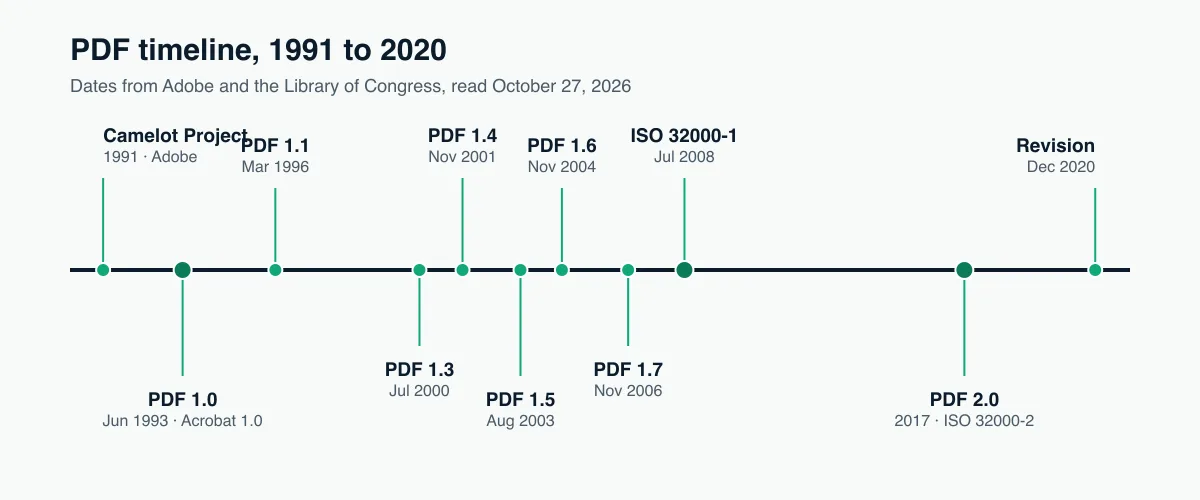
- 1991. Adobe co-founder John Warnock launches the Camelot Project, aiming to let anyone capture a document from any application, send it anywhere and view and print it on any machine. (Adobe)
- 1992. Adobe says Camelot had developed into PDF. (Adobe)
- June 1993. PDF 1.0 and Acrobat 1.0. Library of Congress
- 2001 to 2005. PDF 1.4 (November 2001) becomes the base for the PDF/X standards of 2003 and for PDF/A-1, published in 2005. Library of Congress
- November 2006. PDF 1.7 is released with Acrobat and Reader 8. Library of Congress
- July 2008. PDF 1.7 is published as the ISO standard 32000-1, so PDF is no longer only Adobe's specification. Library of Congress
- 2017 and December 2020. PDF 2.0 is published as ISO 32000-2:2017, and a dated revision follows in December 2020. Library of Congress
New to the format? Start with what a PDF is.
Who invented PDF?
Adobe created PDF. Adobe says its co-founder, Dr. John Warnock, launched "The Camelot Project" in 1991 and that by 1992 the project had developed into PDF. The first public specification, the PDF Reference First Edition for version 1.0, is dated June 1993 and came with Acrobat 1.0.
PDF versions table
Every row comes from the Library of Congress page named in its last column, read October 27, 2026. The Library of Congress pages do not list every feature of the earliest versions, so where a row says little, it is because we only state what the page says.
Every PDF version from 1.0 to 2.0
| Version | Year | Acrobat release | What stands out | Standard | Source |
|---|---|---|---|---|---|
| PDF 1.0 | June 1993 | Acrobat 1.0 | The first published specification, from Addison-Wesley. | Adobe specification | Library of Congress, PDF 1.0 to 1.3 |
| PDF 1.1 | March 1996 | Acrobat 2.0 | First Edition Revised of the Adobe specification. | Adobe specification | Library of Congress, PDF 1.0 to 1.3 |
| PDF 1.2 | November 1996 | Acrobat 3.0 | The specification adds an appendix on how Acrobat versions handle features introduced through 1.2. | Adobe specification | Library of Congress, PDF 1.0 to 1.3 |
| PDF 1.3 | July 2000 | Acrobat 4.0 | Very widely used. It was still the version built into macOS 10.14 (Mojave) in early 2019. | Adobe specification | Library of Congress, PDF 1.0 to 1.3 |
| PDF 1.4 | November 2001 | Acrobat 5 | Can include XMP metadata. The base for PDF/A-1 (2005) and for PDF/X versions published in 2003. | Adobe specification | Library of Congress, PDF 1.4 |
| PDF 1.5 | August 2003 | Acrobat and Reader 6 | In early 2019 it was the version Word 2016 for Windows wrote with Save as PDF. | Adobe specification | Library of Congress, PDF 1.5 |
| PDF 1.6 | November 2004 | Acrobat and Reader 7 | Added 3D data (U3D) and embedded files, so a PDF can act as a container. The base for PDF/E-1. | Adobe specification | Library of Congress, PDF 1.6 |
| PDF 1.7 | November 2006 | Acrobat and Reader 8 | Added the Extensions Dictionary, so others can publish extensions. | ISO 32000-1:2008 (July 2008) | Library of Congress, PDF 1.7 |
| PDF 2.0 | 2017, revised December 2020 | No Acrobat number given by the source | See what PDF 2.0 changed, below. | ISO 32000-2:2017, revised as ISO 32000-2:2020 | Library of Congress, PDF 2.0 |
A PDF file begins with %PDF- followed by its version number, which is how programs know which version a file claims to be.
What PDF 2.0 changed
PDF 2.0 is the ISO standard that succeeds PDF 1.7. The Library of Congress lists these additions:
- UTF-8 is allowed in text strings such as metadata and comments, in addition to the older encodings.
- Better digital signatures, based on the PAdES standard, with structures for long-term validation.
- Improvements to Tagged PDF, the structure that helps screen readers, including a new Aside tag, namespaces for custom tags, and page-number, line-number and Bates numbering artifact types.
- Print production features, such as black point compensation for individual graphic objects and output intents for single pages.
- Document parts and associated files, ideas first used in the PDF/VT and PDF/A-3 standards.
- Support for custom security handlers, by wrapping an encrypted payload in an unencrypted file.
- Movie and Sound annotations are deprecated in favor of RichMedia annotations.
Signatures matter here: what PDF 2.0 improves is the certificate-based kind. A picture of a signature, which is what Sign PDF places, is a different thing.
The ISO family of PDF standards
Besides the main PDF standard, ISO publishes several special-purpose ones. Each limits what a PDF may contain for one job. All rows are from the Library of Congress, read October 27, 2026.
ISO standards for PDF and their years
| Standard | ISO number | Based on | Year | Source |
|---|---|---|---|---|
| PDF 1.7 | ISO 32000-1 | PDF 1.7 | 2008 | Library of Congress, PDF 1.7 |
| PDF 2.0 | ISO 32000-2 | PDF 2.0 | 2017, revised December 2020 | Library of Congress, PDF 2.0 |
| PDF/A-1 (archiving) | ISO 19005-1 | PDF 1.4 | 2005 | Library of Congress, PDF/A-1 |
| PDF/A-2 | ISO 19005-2 | PDF 1.7 | 2011 | Library of Congress, PDF/A-2 |
| PDF/A-3 | ISO 19005-3 | PDF 1.7, plus files of any format embedded | 2012 | Library of Congress, PDF/A-3 |
| PDF/A-4 | ISO 19005-4 | PDF 2.0 (ISO 32000-2:2020) | 2020 | Library of Congress, PDF/A-4 |
| PDF/X (printing) | ISO 15930 | First PDF 1.2, then PDF 1.3 and later | First published 1999; ISO 15930-1 in 2001 | Library of Congress, PDF/X |
| PDF/UA-1 (accessibility) | ISO 14289-1 | PDF 1.7 (ISO 32000-1) | 2014 edition | Library of Congress, PDF/UA-1 |
| PDF/UA-2 | ISO 14289-2 | Newer edition of PDF/UA | 2024 | Library of Congress, PDF/UA-1 |
| PDF/E-1 (engineering) | ISO 24517-1 | PDF 1.6 | 2008 | Library of Congress, PDF/E-1 |
| PDF/VT-1 and PDF/VT-2 (variable data) | ISO 16612-2 | PDF/X-4 and PDF/X-5 | 2010 | Library of Congress, PDF family |
| PDF/VT-3 | ISO 16612-3 | PDF/X-6 | 2020 | Library of Congress, PDF family |
The Library of Congress notes that every PDF/A version stays current, and that nobody is expected to convert older PDF/A files to PDF/A-4. It also notes that PDF/A-4e takes over what PDF/E-1 did. Its pages for PDF/A-3 and PDF/A-4 give different years for part 3 (2012 and 2011); we use 2012, the date on the PDF/A-3 page itself.
PDF/A in one minute
PDF/A-1 limits PDF 1.4 so a file can be read for decades. Audio and video are forbidden, JavaScript and launching other programs are prohibited, every font must be embedded, colors must be device-independent, encryption is not allowed and standards-based metadata is required. It has two levels: A (full) and B (visual appearance only).
PDFinish does not make PDF/A files. If you need to know what is inside a PDF first, the PDF reader opens it, and our guide to what a flattened PDF is explains one common way to lock a form in place.
Related PDFinish tools
- Shrink a big file: compress a PDF.
- Combine or reorder pages: merge PDF files and organize PDF pages.
- Make text selectable in a scan: make a PDF searchable.
- Fill forms in the browser: fill in a PDF form.
Questions people ask
Who invented PDF?
Adobe created PDF. Adobe says co-founder John Warnock launched the Camelot Project in 1991 and that it had developed into PDF by 1992. PDF 1.0 was released in June 1993.
How many versions of PDF are there?
The numbered versions are PDF 1.0, 1.1, 1.2, 1.3, 1.4, 1.5, 1.6 and 1.7, then PDF 2.0, so nine in all. PDF/A, PDF/X, PDF/UA, PDF/E and PDF/VT are separate ISO standards built on them.
What is the latest PDF version?
PDF 2.0, standardized as ISO 32000-2. It was published in 2017, with a dated revision in December 2020, according to the Library of Congress page read on October 27, 2026.
What is PDF 2.0?
PDF 2.0 is the ISO standard that succeeds PDF 1.7. It adds UTF-8 text strings, improved PAdES-based digital signatures, better Tagged PDF, print production features and more.
When did PDF become an ISO standard?
In July 2008, when PDF 1.7 was published as ISO 32000-1.
Which Acrobat release came with which PDF version?
PDF 1.0 came with Acrobat 1.0, 1.1 with Acrobat 2.0, 1.2 with Acrobat 3.0, 1.3 with Acrobat 4.0, 1.4 with Acrobat 5, 1.5 with Acrobat and Reader 6, 1.6 with Acrobat and Reader 7 and 1.7 with Acrobat and Reader 8.
What does the %PDF- at the start of a file mean?
A PDF file starts with the five characters %PDF- followed by its version number, such as %PDF-1.7.
Sources
Every date and version on this page comes from the pages below, which we read on . Facts we could not confirm on one of them are left out.
- Adobe: What is a PDF? Portable Document FormatRead October 27, 2026. Used for: What PDF stands for, who created it, the Camelot Project (1991) and PDF by 1992, the open standard maintained by ISO.
- Library of Congress: PDF (Portable Document Format) FamilyRead October 27, 2026. Used for: How the PDF versions and the PDF/A, PDF/X, PDF/UA, PDF/E and PDF/VT standards relate; ISO 16612 parts and years.
- Library of Congress: PDF, versions 1.0 to 1.3Read October 27, 2026. Used for: Dates and Acrobat releases for PDF 1.0 (June 1993), 1.1 (March 1996), 1.2 (November 1996) and 1.3 (July 2000).
- Library of Congress: PDF, version 1.4Read October 27, 2026. Used for: PDF 1.4 published November 2001 with Acrobat 5; file extension pdf and media type application/pdf; XMP; basis for PDF/X and PDF/A-1.
- Library of Congress: PDF, version 1.5Read October 27, 2026. Used for: PDF 1.5 released August 2003 with Acrobat and Reader 6.
- Library of Congress: PDF, version 1.6Read October 27, 2026. Used for: PDF 1.6 dated November 2004 with Acrobat and Reader 7; 3D (U3D) and embedded files; basis for PDF/E-1.
- Library of Congress: PDF, version 1.7 (ISO 32000-1:2008)Read October 27, 2026. Used for: PDF 1.7 released November 2006 with Acrobat and Reader 8; published as ISO 32000-1 in July 2008; the Extensions Dictionary.
- Library of Congress: ISO 32000-2, PDF 2.0Read October 27, 2026. Used for: PDF 2.0 as ISO 32000-2:2017 with a December 2020 revision, and the features it added.
- Library of Congress: PDF/A-1 (ISO 19005-1)Read October 27, 2026. Used for: PDF/A-1: ISO 19005-1:2005, approved May 2005, published October 2005, and its constraints.
- Library of Congress: PDF/A-2 (ISO 19005-2)Read October 27, 2026. Used for: PDF/A-2 published 2011 on PDF 1.7.
- Library of Congress: PDF/A-3 (ISO 19005-3)Read October 27, 2026. Used for: PDF/A-3 published October 2012; embedded files in any format.
- Library of Congress: PDF/A-4 (ISO 19005-4)Read October 27, 2026. Used for: PDF/A-4 approved November 2020 on ISO 32000-2; all PDF/A versions stay current.
- Library of Congress: PDF/X (ISO 15930)Read October 27, 2026. Used for: PDF/X first published in 1999; ISO 15930-1:2001; prepress exchange.
- Library of Congress: PDF/UA-1 (ISO 14289-1)Read October 27, 2026. Used for: PDF/UA-1 is ISO 14289-1:2014; PDF/UA-2 is ISO 14289-2:2024; accessibility.
- Library of Congress: PDF/E-1 (ISO 24517-1)Read October 27, 2026. Used for: PDF/E-1: ISO 24517-1:2008, engineering documents on PDF 1.6.
PDFinish is not affiliated with Adobe or the other organizations named here. Pages are written in our own words; see how we write and check them in the editorial policy.